
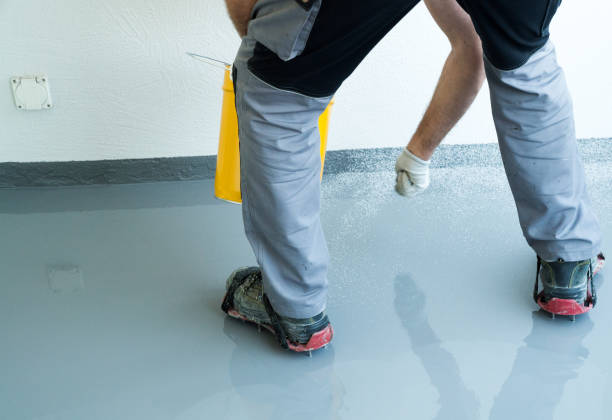
Hidden moisture can weaken a coating long before damage appears on the surface. Professional testing shows whether vapor is moving through the slab and whether the concrete can safely accept epoxy flooring. Accurate results help installers choose the right primer, preparation method, and coating system before work begins.
Why Can a Dry-Looking Slab Still Hold Moisture?
Concrete contains tiny pores that allow water vapor to travel upward from the ground or deeper parts of the slab. Although the surface may feel completely dry, moisture can remain below it and rise after a nonporous coating seals the floor. That pressure may cause bubbles, cloudy areas, soft spots, or sheets of epoxy that separate from the concrete.
Groundwater, recent rain, plumbing leaks, cleaning, humidity, and missing vapor barriers can all affect moisture levels. Older buildings may present added uncertainty because original slab details are not always available. For that reason, reliable epoxy floor companies use measurements instead of judging the concrete by sight or touch.
How Relative Humidity Testing Measures Moisture Inside Concrete
Relative humidity testing checks conditions within the slab rather than only at its surface. Installers drill small holes to a specified depth, remove loose dust, place testing sleeves, and allow the holes to reach equilibrium before inserting calibrated sensors.
Results show the percentage of relative humidity inside the concrete. Higher readings suggest that moisture could move toward the surface after an epoxy garage floor is installed. Manufacturers set acceptable limits for their products, so the contractor compares the measurements with the requirements of the proposed primer and coating system.
Multiple sensors are often placed across larger areas because moisture rarely spreads evenly. Doorways, exterior walls, drains, low spots, and previously damaged sections may produce readings that differ from the center of the room.
What Happens During an In-Slab Moisture Test?
A proper in-slab test follows controlled steps so outside conditions do not distort the findings:
- Technicians select test locations based on floor size and slab layout.
- Crews drill each hole to the required depth for the slab type.
- Vacuums remove dust that could affect sensor placement.
- Protective sleeves isolate the test area from room air.
- Calibrated probes record humidity and temperature after equilibration.
- Contractors compare every result with the coating manufacturer’s limits.
Careful documentation gives property owners a clear record of conditions before commercial epoxy flooring begins. Those readings also help explain why one area may need a different primer or moisture-control treatment.
Calcium Chloride Testing Checks Vapor at the Surface
Calcium chloride testing measures how much moisture vapor leaves a defined area of concrete over a set period. During the test, a technician weighs a dish of dry calcium chloride, places it beneath a sealed cover, and later weighs it again to calculate how much moisture the material absorbed.
Unlike relative humidity testing, this method evaluates vapor emission near the slab surface. Surface conditions, recent grinding, air movement, temperature, and cleaning can influence the result, so installers must follow the test procedure carefully. A single reading also represents only a small section of floor, making several test locations necessary in many projects.
Property owners searching for epoxy floors near me may hear contractors mention moisture vapor emission rate. That term refers to how much water vapor passes through a measured floor area during a specific time.
Do Handheld Moisture Meters Provide Enough Information?
Handheld meters offer quick, non-destructive readings and help contractors identify areas that may contain more moisture than others. Scanning the slab can reveal patterns around cracks, drains, walls, doors, or plumbing lines before more detailed tests begin.
However, meter readings often serve as comparative information rather than final approval for coating. Concrete density, aggregate, surface contamination, and embedded materials may affect the device. Experienced installers use these tools to locate concerns, then confirm conditions with testing methods accepted by the product manufacturer.
Warning Signs That Lead to Additional Moisture Testing
Visible conditions cannot replace formal testing, but they often show where closer inspection is needed:
- White mineral deposits along cracks or joints
- Dark patches that return after drying
- Rust near embedded metal or floor fixtures
- Musty odors in enclosed rooms
- Previous coatings with bubbles or peeling areas
- Dampness beneath stored boxes, mats, or equipment
These signs may point to vapor movement, leaks, condensation, or poor drainage. Anyone comparing epoxy flooring near me providers should ask whether the contractor investigates the source rather than simply coating over the evidence.
How Temperature and Humidity Affect Test Results
Room conditions influence how moisture behaves within a slab. Air conditioning, open doors, seasonal humidity, and recent weather changes can alter surface readings, especially if the building has not reached normal service conditions.
Testing works best when the room reflects the environment expected after installation. Warehouses, garages, and unfinished buildings may require extra attention because their temperature and humidity can change widely throughout the day. Contractors should also measure the slab temperature and dew point before applying epoxy floors, since condensation can form even when the concrete passes a moisture test.
What Happens When Moisture Levels Are Too High?
High readings do not always mean the flooring project must be abandoned. Depending on the source and severity, installers may recommend more drying time, leak repair, drainage correction, a moisture-tolerant primer, or a full vapor-mitigation system.
Product selection matters because not all primers can handle the same conditions. Applying standard epoxy over a slab that exceeds its moisture limit creates a high risk of adhesion failure. Searches for an epoxy garage floor near me should therefore focus on companies that explain both the test results and the proposed response.
Testing Protects the Entire Flooring System
Surface grinding, crack repair, mixing, and application cannot overcome uncontrolled moisture moving through concrete. Proper testing allows the coating specification to reflect the slab’s real condition instead of relying on assumptions.
Elite Coastal Epoxy evaluates moisture before installing residential, commercial, and industrial floor coatings. Its team can test the concrete, identify potential vapor concerns, prepare the slab, and recommend an epoxy garage floor or commercial system suited to the measured conditions.